The metabolic-backbone identity of Rethiamine™
RetaBone™: Retatrutide, Nutrition and Structural Metabolism Research
RetaBone™ is not a separate formulation. It is the body-composition and metabolic-resilience identity of Rethiamine™, Panacea Bio Chem’s proprietary dual-layer Peptourbillon™ containing a 5 mg retatrutide lower layer and a 20 mg thiamine upper layer within Lyoprester SS™, reconstituted by 0.5 mL P-EARLs™.
RetaBone™ represents the metabolic-backbone and body-composition research identity of the same Rethiamine formulation.
The RetaBone name does not mean that the formulation has been demonstrated to increase bone density, prevent fractures or preserve skeletal muscle. These remain separate scientific questions requiring dedicated study.
BEYOND THE SCALE
Rapid weight loss changes more than fat mass
Body weight is not one thing. It includes fat mass; lean tissue; water; connective tissue; bone mineral. When weight falls quickly — as it does under potent incretin pharmacology — every one of those compartments can move, and they do not move in proportion.
Body-composition outcomes require direct measurement rather than assumptions from scale weight. A 20 kg loss and a 20 kg fat loss are different statements, and only one of them is measurable on a bathroom scale. That distinction is the reason RetaBone exists as a research identity.
THE COMPOSITION EVIDENCE
Retatrutide and lean mass: a neutral reading of the record
Retatrutide body-composition research indicates that fat mass decreases substantially, while some lean-mass reduction may also occur. The proportion should not be exaggerated into 'muscle destruction,' because DXA lean mass also includes water and non-muscle lean tissue.
The only published retatrutide DXA dataset — the phase 2 body-composition substudy in type 2 diabetes ↗ — measured total fat mass falling by up to 26.1% at week 36, with the authors reporting the lean-mass share of weight loss as similar to other obesity treatments. What it supports: retatrutide preferentially reduces fat mass. What it does not prove: anything about muscle function, bone outcomes, or composition in people without diabetes — and 103 of 189 substudy participants completed both DXA scans.
The benchmark is the SURMOUNT-1 tirzepatide DXA substudy ↗: −33.9% fat mass and −10.9% lean mass at week 72, with roughly 75% of weight lost as fat and ~25% as lean mass. A 35-trial systematic review ↗ found a median ~28.3% of weight lost on incretin therapies attributable to muscle-based indices — and no included study reported objective physical-function outcomes. Both the concern and the evidence gap are real.
RESEARCH WATCH
Trending Research & News
Last updated: 2026-08-07
2026-07-08
Nutritional, functional, and psychological considerations for incretin-based therapies in adults — an EASO, EFAD, and ECPO Consensus Statement
incretin nutrition consensus
The first tri-society consensus on nutrition during incretin therapy — protein targets, resistance exercise, and explicit micronutrient-risk monitoring during rapid weight loss. Directly frames the nutritional-resilience rationale behind pairing retatrutide with thiamine in this formulation.
Peer-reviewed review
2026-07-01
Effect of Incretin-Based and Nonpharmacologic Weight Loss on Body Composition: A Systematic Review
lean mass loss benchmarks
35-trial systematic review finding a median of ~28% of weight lost on incretin therapies comes from muscle-related indices, with two-thirds of studies exceeding the ~25% benchmark — the core evidence base for RetaBone’s body-composition focus. (Epub 2026-04-17; issue July 2026.)
Peer-reviewed review
2026-06-17
GLP-1 Receptor Agonists for Obesity Management in Older Adults: A Scoping Review on the Risk of Sarcopenia and Sarcopenic Obesity
sarcopenic obesity risk
Synthesises sarcopenia and sarcopenic-obesity risk in older adults on GLP-1 RAs, citing protein intakes of 1.2–1.6 g/kg/day plus resistance training as mitigation — the exact risk phenotype this research hub tracks.
Peer-reviewed review
2026-06-13
Efficacy and safety of retatrutide, a GIP, GLP-1, and glucagon receptor agonist, in people with type 2 diabetes and inadequate glycaemic control with diet and exercise (TRANSCEND-T2D-1): a double-blind, randomised, phase 3 trial
retatrutide phase 3
First published phase-3 retatrutide result: 11.5–15.3% body-weight reduction at 40 weeks with HbA1c −1.69 to −1.94% as monotherapy in type 2 diabetes. Confirms the potency of the molecule at the heart of this research formulation. (Epub 2026-06-06.)
Peer-reviewed human study
2026-06-05
Optimizing Weight Loss in the GLP-1 Era: Preserving Muscle Mass, Function and Metabolic Health Through Precision Nutrition and Resistance Training
weight loss quality
Proposes a "high-quality weight loss" framework — preferential fat reduction with preserved muscle, function, dietary adequacy, and bone — and notes that total weight alone cannot distinguish fat, lean tissue, water, and bone. Aligns with RetaBone’s beyond-the-scale thesis.
Peer-reviewed review
2026-01-01
Impact of Semaglutide on fat mass, lean mass and muscle function in patients with obesity: The SEMALEAN study
semaglutide lean mass
Prospective DXA study (n=106 completers) showing 13% weight loss at 12 months with lean-mass decline that stabilised after month 7, improved handgrip strength, and sarcopenic-obesity prevalence falling from 49% to 33% — rare functional (not just compositional) outcome data. (Epub 2025-10-09; issue January 2026.)
Peer-reviewed human study
2025-08-01
Effects of retatrutide on body composition in people with type 2 diabetes: a substudy of a phase 2, double-blind, parallel-group, placebo-controlled, randomised trial
retatrutide body composition
The only retatrutide DXA body-composition dataset published to date: up to 26.1% total fat-mass reduction at week 36 (8 mg pooled), with authors reporting the lean-mass share of weight loss as similar to other obesity treatments. Anchor evidence for the site’s retatrutide body-composition coverage. (Epub 2025-06-30; issue August 2025.)
Peer-reviewed human study
2025-05-01
Body composition changes during weight reduction with tirzepatide in the SURMOUNT-1 study of adults with obesity or overweight
tirzepatide DXA substudy
The SURMOUNT-1 DXA substudy (n=160): −33.9% fat mass and −10.9% lean mass at week 72, with ~75% of weight lost as fat and ~25% as lean mass in both tirzepatide and placebo arms — the benchmark proportion against which retatrutide data are read. (Epub 2025-02-25; issue May 2025.)
Peer-reviewed human study
2026-09-01
Weight Loss-Dependent Changes in Body Composition and Bone Health in People With Obesity and Type 1 Diabetes Treated With Liraglutide, Semaglutide, or Tirzepatide
body-composition watch
1. Diabetes Metab Res Rev. 2026 Sep;42(6):e70213. doi: 10.1002/dmrr.70213. Weight Loss-Dependent Changes in Body Composition and Bone Health in People With Obesity and Type 1 Diabetes Treated With Liraglutide, Semaglutide, or Tirzepatide.
Observational study
2026-09-01
Effects of Oral Semaglutide on Dietary Intake and Body Composition in Japanese People With Type 2 Diabetes: A Prospective Observational Study in Clinical Practice
body-composition watch
1. Endocrinol Diabetes Metab. 2026 Sep;9(5):e70295. doi: 10.1002/edm2.70295. Effects of Oral Semaglutide on Dietary Intake and Body Composition in Japanese People With Type 2 Diabetes: A Prospective Observational Study in Clinical Practice.
Observational study
2026-08-06
Integrating GLP-1 Receptor Agonists Into Dermatology Practice: Safety and Monitoring Strategies
body-composition watch
1. Clin Dermatol. 2026 Aug 6:S0738-081X(26)00210-5. doi: 10.1016/j.clindermatol.2026.07.030. Online ahead of print. Integrating GLP-1 Receptor Agonists Into Dermatology Practice: Safety and Monitoring Strategies. Narla S(1), Narla RR(2).
Peer-reviewed study
2026-08-03
Protecting Musculoskeletal Development and Physical Function in Adolescents on GLP-1 Therapy
body-composition watch
1. Child Obes. 2026 Aug 3:21532176261475103. doi: 10.1177/21532176261475103. Online ahead of print. Protecting Musculoskeletal Development and Physical Function in Adolescents on GLP-1 Therapy. Smith WA(1)(2), Kim A(3)(4), Khalil TJ(5), Giovinazzo C(5), Burton ET(5)(6)(7).
Peer-reviewed study
READOUT WATCH
TRIUMPH-4: retatrutide in obesity with knee osteoarthritis
Announced 2025-12-11 · status: company announcement and conference reporting — the peer-reviewed publication is pending
On 2025-12-11 Eli Lilly announced topline phase 3 results from TRIUMPH-4 — the first retatrutide phase 3 readout with a musculoskeletal outcome: 445 adults with obesity and knee osteoarthritis, randomised to retatrutide 9 mg or 12 mg or placebo for 68 weeks. Average weight reduction reached 28.7% (−32.3 kg), and the WOMAC pain score fell by 4.5 points (−75.8%); more than one in eight participants were pain-free at week 68. Gastrointestinal adverse events were the most commonly reported.
What this readout does and does not establish. TRIUMPH-4 measured pain and function — not body composition, not bone density. It does not answer the lean-mass, muscle or bone questions this site tracks, and it cannot separate the drug’s effect on joint pain from the mechanical effect of removing more than a quarter of body weight from the joint. The DXA, strength and bone data expected from the wider TRIUMPH programme remain the readouts that matter for those questions; this entry will be updated when the peer-reviewed TRIUMPH-4 publication appears.
Company announcement + conference reporting
Source: Eli Lilly investor release (2025-12-11); Healio and Rheumatology Advisor conference reporting. All figures above are topline and await the peer-reviewed publication.
NUTRITIONAL RESILIENCE
Why nutritional resilience matters
When appetite is pharmacologically suppressed, intake falls — and with it, the margin for error on everything intake normally supplies. The pillars of nutritional resilience during major weight reduction are not exotic: adequate protein; micronutrient intake; resistance exercise; hydration; clinical monitoring; attention to gastrointestinal symptoms; and the rate of weight reduction itself.
The 2026 EASO, EFAD and ECPO consensus statement ↗ — the first tri-society consensus on nutrition during incretin therapy — calls for protein targets, resistance exercise and explicit micronutrient-risk monitoring during rapid weight loss. What it supports: structured nutrition belongs inside incretin treatment research. What it does not prove: that any single nutrient, at any dose, prevents lean-mass or bone outcomes on its own.
Nothing on this site implies that a 20 mg thiamine component replaces a complete nutrition programme. It does not.
THE METABOLIC BACKBONE
Thiamine and the metabolic backbone
Thiamine — vitamin B1 — participates in energy-producing biochemical pathways and nervous-system function. It is required for the enzymatic systems that convert carbohydrate into cellular energy, and humans maintain only limited thiamine reserves. That is the entire basis for taking it seriously in a formulation that changes how much people eat.
RetaBone explores whether thiamine integration may contribute to a more nutritionally considered retatrutide formulation architecture.
The boundaries are stated, not implied. This site does not claim that thiamine prevents retatrutide muscle loss, builds bone, or substitutes for protein and resistance training. Direct retatrutide-induced biochemical depletion of thiamine has not been established. The research question is nutritional vulnerability — and it is answered by measurement, not assumption.

Bogdan Dicoias — Panacea Bio Chem Ltd
THE RESEARCH ORIGINATOR
Bogdan Dicoias on studying what remains after weight loss
“Weight loss is not the whole outcome. The structure, energy and function that remain must be studied with equal seriousness.” — Bogdan Dicoias, Panacea Bio Chem
BONE: KNOWN AND UNKNOWN
Bone health: what is known and unknown
Major weight loss can influence mechanical loading and body composition — and bone lives inside both. What is known: the load bone carries changes when body weight changes, and fat-free mass, muscle, bone and hematopoietic health move together in the weight-loss literature. What is unknown is larger: evidence regarding individual incretin therapies and bone outcomes remains developing, and long-term fracture or functional outcomes of incretin-associated bone effects remain unestablished.
Rethiamine has not been demonstrated to preserve bone mineral density. Appropriate research would require DXA, bone-turnover markers and controlled longitudinal evaluation — the instruments of measurement, applied over time, before any claim.
ONE FORMULATION
Same formulation, different scientific lens
Rethiamine™
Product and formulation identity
The definitive formulation name — what it is, who developed it, and how Lyoprester SS delivers it. Rethiamine retatrutide and thiamine formulation ↗
Reta-B1™
Thiamine and technical evidence identity
The technical hub — retatrutide and vitamin B1 evidence, thiamine analysis, formulation compatibility. Reta-B1 technical evidence hub ↗
RetaBone™
Body-composition and metabolic-resilience identity
This site — lean mass, muscle, bone-health research, nutritional resilience and the structure that remains after weight loss.
All three describe the same proprietary Panacea Bio Chem formulation: a 5 mg retatrutide lower layer and a 20 mg thiamine upper layer, co-lyophilised as a dual-layer Peptourbillon™ in Lyoprester SS™ and reconstituted by 0.5 mL P-EARLs™.
THE PANACEA TECHNOLOGY ESTATE
One formulation inside a connected research ecosystem
RetaBone sits at the end of a chain of Panacea platforms — from the Lyoprester SS single-shot architecture to the dual-layer Peptourbillon and the 0.5 mL P-EARLs reconstitution system — and beside its two sibling identities.
THE PANACEA TECHNOLOGY UNIVERSE
Twenty-four technologies, each the leader of its class
Proprietary Panacea Bio Chem Ltd technologies, invented by Bogdan Dicoias — what each one does, and why it leads its class.

Lyoprester®
The only dual-chamber cartridge that is autoreconstitution-enabled, vacuum-sealed and argon-fillback.
Cake and liquid never meet until the moment of use — no contamination, no transfer, no compromise. A conventional vial wets only the surface; the Lyoprester carries Peptourbillon loads approaching 200 mg.
Lyoprester SS: screw a needle, inject, throw.

P-EARLs™
Panacea-Engineered Aseptic Reconstitution Liquid(s) — each tuned to the peptide it wakes.
Bacteriostatic water is a fine diluent and nothing more. A P-EARL is engineered around the peptide’s pI-aggregation behaviour and its Met/Cys/His/Trp oxidation profile.
GHK-Cu: a chelation-withholding liquid design, not generic water.

Peptourbillon™
The layered peptide formulation architecture — single- or multi-layer, never a blend.
Each active keeps its own lyophilised phase: near-eutectic layering, ultrasound freezing, −80 °C stack, RF-assisted drying. Chemistries that would destroy each other in a blend arrive as neighbours, not mixtures.
Dual-layer cakes: one active below, a second above — one chamber, zero contact.
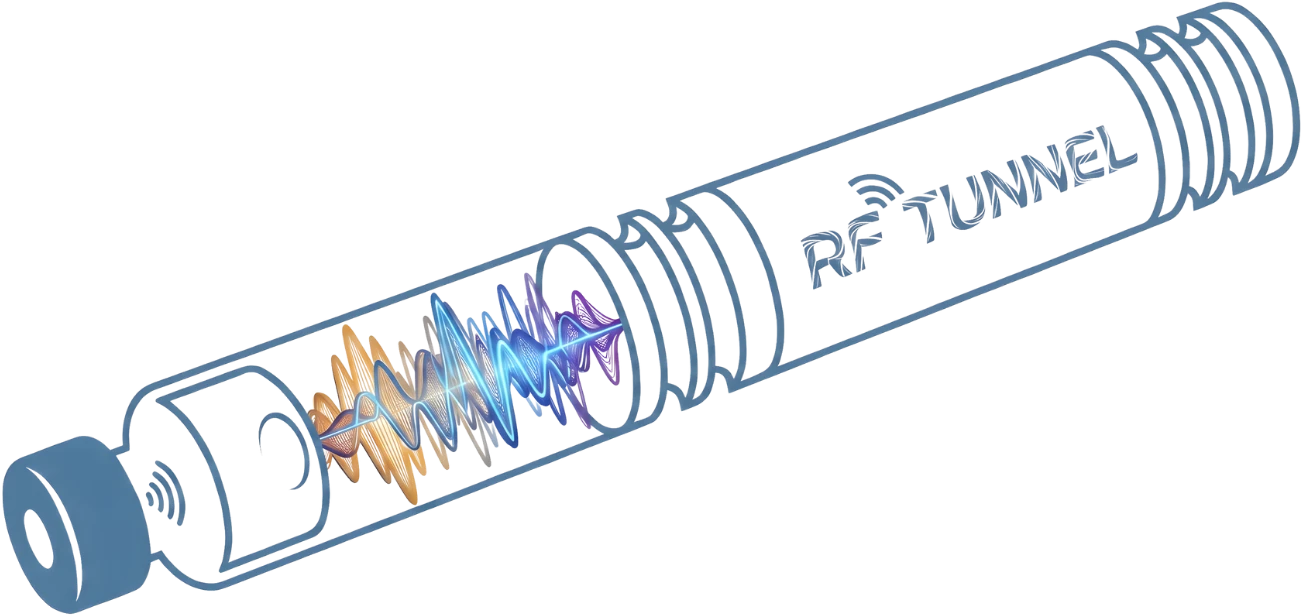
RF Tunnel™
The RF-formed central channel through the cake.
Two wetting fronts instead of one — reconstitution solved by geometry, not surfactants.
The hard cases: heavy-loaded, lipidated (GLP-class) and gel-blocking APIs.

TgShift™
Raises the cake’s glass-transition temperature with RF — instead of chilling below it.
Drying runs warmer and faster while the structure stays below collapse — cycles shorten from days toward hours.
Reference points: trehalose ≈ −29 °C, sucrose ≈ −32 °C — shifted upward, not endured.

Cryolapse™
Cryogenic pressure collapse under S3Pulse™ control — vapour redistributed through the whole cake, not its surface, impeding crust formation.
A collapse, not a yank: vapour redistributes gently through the whole lyocake instead of being driven off its surface, which impedes crust formation. Cryopumping to −110 °C, surfactant-free.
A representative peptide cycle pulled from ~13 hours toward ~4, without a surfactant in sight.

LyoLevit™
The cake levitates and spins in high orbit — driven by ultrasound and RF.
Company-reported zero-contact processing: 99% reproducibility, 89% energy reduction, a 4–6× gain in sublimation surface.
No shelf contact means no hot spots — uniformity is the mechanism, not the hope.

Lyochrysalis™
The integrated chamber housing the whole drying stack.
It finishes cold — it never cooks the peptide. No +40/+60 °C secondary bake, so binding affinity and bioavailability survive.
TgShift + LyoLevit + Cryolapse + DiastolVAC + S3Pulse in one housing.

S3Pulse™
The control brain for every piece of Panacea hardware.
Sixteen relay channels, three dipped product probes as the authority, Cryo-Triad event detection and a Kv-learning adaptive ramp — the only platform that enables every other technology.
14,909 automated contract tests stand behind the control law.

Liquiprester™
The single-liquid cartridge engineered so multiple peptide APIs coexist in one shared vehicle.
The glass may vary, the dose must not: a fixed plunger datum with ElimiVoid, bore-variance self-counterbalancing, and IncreSure verification per increment.
Dose accuracy that survives manufacturing tolerance — by design, not inspection.

Syntheseract™
Continuous-flow peptide synthesis in a special, very fast and economical way.
Batch synthesis is “more product, blindly”; Syntheseract is scalable production, observed — 64 positions, 128+ addresses, and a Digital Batch DNA for every run.
Sprint, Economy and Fortress modes — the economics chosen per peptide, not per habit.

CFSPPS™
Continuous-flow solid-phase peptide synthesis, written as its own category.
Setpoint ≠ experience: in flow, every residue addition is observed and repeatable instead of assumed.
The category reference the field reads before arguing.

OxyDeplete™
Degassing plus no-headspace doctrine — the oxygen-starved seal.
Trapped oxygen does not escape, it reacts. Remove it first and stability extends into years instead of months.
Air seal vs oxygen-starved seal: the comparison the oxidation model is built on.

ArgonLock™
The final inert-atmosphere lock under argon.
After drying, the cake is backfilled and sealed under argon — the principle that protects welding arcs, wine cellars and the Charters of Freedom, applied to peptides.
Air vs vacuum-only vs ArgonLock — the three-face comparison, settled.

RedoxVault™
Separation, not merely suppression — redox isolation in lipid micro-reservoirs.
A few ppb of iron can outweigh grams of antioxidant; the vault removes the catalyst from reach, with depot and delayed-release microsphere formats on top.
A strongroom at the scale of a droplet — the ferritin principle, engineered.

PleniDose™
The shared filling gantry — one machine filling both the dual-chamber Lyoprester and the liquid Liquiprester.
Only the rods holder changes between the two product lines; the rear-plunger datum is fixed and pen-compatible. The glass may vary — the dose must not.
Known inside the machine software as the Lyochrysalis Gantry: one gantry, two product lines.

IncreSure™
The dose-metrology layer — verified API per pen increment.
The printed “60 IU” dial figure is not the API in the cartridge and not the volume per click. IncreSure characterises seven real pen parameters instead of trusting the label — a Cryolapse-enabled discipline.
Piston travel per increment: measured, never assumed.
ElimiVoid™
Front-void elimination without touching the metered dose.
It removes the compressible air pocket ahead of the dose — without moving the rear plunger, without withdrawing API, without changing the delivered increment. A Cryolapse-enabled operation.
The completion liquid is API-free, buffer-free and engineered to stay out of the way.

Cryoviscous™
The characterised cold, high-viscosity, low-mobility conditioning state.
The formulation is held temporarily still — strongly flow-restricted — for precision cartridge filling, then recovers within acceptance criteria on controlled warming.
A processing state, not merely “cold liquid”.

Vana Machine™
Vacuum Assisted Needle Accessory — vacuum conditioning and plunger-locking for the cartridge.
It prevents air gaps and plunger drift, landing the target vacuum inside the Lyopresters and keeping it there until the moment of use.
The machine that vacuum-conditions the cartridge before it ever meets a needle.

EZnject™
The disposable auto-injector pen built around the Lyoprester.
One twist activates autoreconstitution — the P-EARLs is drawn into the peptide chamber at the septa. A hundred indexed 0.1 mL doses with lab-grade accuracy; ships with 31G/5 mm needles and a Peptourbillon pre-loaded.
One twist — no vial, no syringe, no transfer.

Dicoias Ψ
The computed-chemistry advisory — every substance reduced to a vector across physical, electronic and formulation space.
Structure-guided descriptors first, laboratory work second: the Ψ advisory ranks excipients, vehicles and layer candidates before the first bench run — the selection layer behind Panacea formulation decisions.
The molecule’s structure reads the shortlist before the bench hears it.

SealoPrester™
Aseptic Cartridge Closure System — Seal o’ Precision + Sterility.
It mechanically seals the caps of vacuum-charged, argon-locked cartridges that arrive held together by vacuum alone — one wrong move and the cartridge self-reconstitutes or loses its atmosphere. In cahoots with VANA, it gives birth to the Lyoprester.
The machine that turns a banal dual-chamber cartridge into a Lyoprester.

Peptidic Liquid
The peptide formulation in solution — the active plus its buffers, cryoprotectants, lyoprotectants and scaffolders.
A peptide is only as good as the liquid it lives in: this is the formulation that decides whether a dose survives freezing, drying, storage and the journey back to solution. Designed with Dicoias Ψ.
The liquid every Lyoprester is born from and every Liquiprester keeps.
RETABONE™
Beyond weight loss: investigating the metabolic structure that remains.
Retatrutide, nutrition and body composition — examined as one system, with every evidence tier and limitation attached.